- a ritual of sorts
- Cleaning up the shed
- evidence of tampering
- The Knot and Fermat
- shed as a metaphor for organization
A ritual of sorts
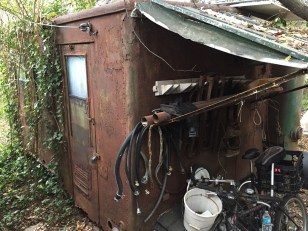 Benny followed a ritual of sorts when he needed something from his shed. He wouldn’t have thought about it as a ritual, but that’s what it was, because he was about to enter his Fortress of Solitude. Not much of a fortress perhaps, and not that much solitude. He unlocked the door, replacing the lock in its hasp where it would be ready when the time came to lock the shed back up. If it had rained in the last few days, he would bend into the darkness inside, pick up one, and then another long narrow mud pans that he used for plaster or patching compound, empty them of collected rain water that had leaked inside, and then place them back just inside the doorway.
Elliot knew Benny well enough by this time not to have to ask. What would he want to go to all the bother of fixing the roof for? It’s so much easier to simply catch the leaks in basins and empty them as needed. This strategy served a duel purpose because it created a threshold to the shed that anyone with a couple of weeks experience living at the Garfield Street House would know that Maggie would never cross. It was just too primitive for her liking.
What were men anyway? What could they possibly be thinking? They hardly seemed a step or two above dogs. Indeed, Maggie had seen Benny race Luna to a piece of food that had fallen from the table. Benny ate it as if it were nothing to remark about. If anything, it was more as in triumph of a great victory he’d announced, “I get the food because I am the Master and you are just a dog.” Men would sleep on the ground; they’d eat off the floor; they’d scratch at their fleas; they’d go for indeterminable time without bathing. And what of the smell if left to themselves? Would they ever bathe? Would they eventually notice their own rank odor after a couple of weeks or months? Or would they slowly get used to their own stench and find it part of the natural environment?
Was there gender bias in industrial pollution? Would women ever even think about trashing up the environment the way men do? Maggie couldn’t be sure one way or the other, but she suspected that women would be more likely than not to attempt to steer corporate enterprise into a different orientation, away from that of men in the past and towards the sensible, sound, and rational way of women that represented the future. The young women, the young dawn, the new young world looking around and seriously considering its predicament, its hopes and promise for the first time.
Elliot would keep his secret about the piss bottle, which, as far as Elliot could fathom, was commonplace to a certain segment of male society with the informality with which Benny had handed the bottle to Elliot inviting him to use it as Benny just had.
————————-
Cleaning up the shed
Benny knew from sad experience that anytime he was about to implement a task such as cleaning up his shed, one of the most important rules was to leave enough time to get the job completed. If he didn’t finish the job, then he’d be stumbling over it every time he tried to move onto something else. True, there were drawbacks to this strategy. He paused for a moment to notice the pile of heavy tools, chains, artifacts, and miscellaneous things that had set unmoved for a year or more. Since the workbench was already overflowing, he needed a new shelf to hold the stuff that had been piling up on the floor and blocking his access to the stuff beyond easy reach of the door. He had to clear the floor pile to get comfortably inside, to be able to build the shelves that would hold the stuff on the floor to get it out of the way. He picked up and studied a burned out light bulb with a “Hmm.” What was he thinking – that he’d find time to fix a burned out bulb?
Enough! He dropped the bulb into a bucket overflowing with trash and resolved to finally clean up the place. There had been enough time elapsed since the last time Maggie nagged him to clean up his shed that he could do so now without appearing to acquiesce to her demands.
[(Need? – He needed Elliot’s help to move a particularly large, heavy box out of a dark, dusty corner into the light of day. Inside the box was the tool he was looking for earlier when he’d been distracted by the chess column. “Ah! Eureka! I’ve found it!” He took off his belt and positioned it between the two thick sturdy prongs of the tool.
Elliot couldn’t figure out what it was until Benny squeezed the tool’s handle and punched an additional hole in the leather belt. “Have you been losing weight?” Elliot asked.
“I guess so. All my pants are too big lately.” (As if his exercise has been paying off.)]
Find parts about the shed/garage re Terry. Benny could be remembering this earlier experience when he finds some evidence of tampering.
Benny stepped down the old brick steps into the pleasant night air tapping his flashlight gently to bring a little oomph into the feeble batteries. The weak spotlight lit the rear walk leading toward the garage just enough to see just a step or two ahead. It occurred to him that it might be a good idea to replace the burned out back porch light one of these days. But that would require getting the ladder out from behind a bunch of stuff, and that seemed like an awful lot of work. He had walked this way a hundred times at night over the years and could manage fine with just a flashlight.
But never before tonight had he come across a prowler. The moment he opened the rattly side door, a sudden movement in the dark black garage was followed by his startled yelp. A shadow ran out the open door into the alley as Benny flailed about in stark raving terror for the dangling string that would turn on the garage light. By the time he had the square room illuminated with the relative security of the single bare bulb, the intruder’s running footsteps were long gone down the alley and disappeared around the corner to (~Ontario Road).
He timidly stepped out into the alley and peered each way looking for any signs of life. Seeing none, his confidence returned and he grumbled audibly, “Stupid kids!” Despite the numerous teenagers that ambled up and down the alleyway at all times of night and day, there had never been much trouble. There wasn’t anything of value to steal. It was obvious that some neighborhood kid had been monkeying around where he had no business being. The kid was surely harmless, but he vowed to replace the porch light the next day anyway.
Walking back to the house, he wondered if he should tell the others of his ordeal to caution them to be on the look out or whether that would just disturb them unnecessarily? He decided against the warning if for no better reason that Maggie might get some notion in her head that the broken garage doors needed repair.
As if that would keep a determined burglar out! He never kept anything in the garage that anyone would want to steal (which was the best protection against thievery, after all), so what would the point of that be? Except more unnecessary work?
Wait a minute. What was it that he wanted from the garage in the first place? (~Ah! Glue. Right.) He did a quick about-face and took several steps back towards the garage before his unsettled nerves got the best of him. He did another about-face back towards the house determined to put his task off until the light of day.
The Knot and Fermat
When Elliot returned from his outing, Maggie was fussing at Benny that his shed was a total disaster and he needed to clean that place out and get rid of all the junk he had accumulated back there. “Like this rope, for example.” She waved a tangled mass of rope menacingly to prove her point.
He shrugged with his palms up by way of explanation and a dopey grin on his face staring off to the side. “It’s a perfectly good rope! Do you have any idea what quality rope costs these days?”
“But it’s a tangled mess! It’s useless like this!” she complained.
Benny tried to calm her saying, “I know. I know. It’s okay. I’ve got it under control. You just need to know how to untangle knots, and then it’s a perfectly good rope.”
Again, waving the rope, she protested, “What are you talking about? It’s been out in the rain. It’s caked with dirt! These knots are hard as rocks! You’ll never get them out …”
“Let me show you something,” Benny began, but Maggie cut him off.
“I’m tired of your tricks! I just want you to clean this place up!” With that, she stormed off.
Shaking his head with a sigh in sincere pity for his poor wife, he carefully began to pick at a bulge in one of the knots near the end of the rope. She just didn’t have the patience and stamina and – dare he say it? Creative imagination? – to recognize all the useful and valuable resources he had so painstakingly collected and cataloged around their house.
At first, the knot’s bulge wouldn’t budge, but Benny was sure that if he kept applying the right pressures to each side of the lump, it might loosen just a bit, just enough to then loosen an adjacent strand of the rope. Sometimes you just have to give problems a little time and leave them off on their own so they can have a chance to figure themselves out. Any problem is a puzzle waiting to be solved. Hoping to be solved! It was as if the knot was a primitive life form, a furry little kitten wanting to be touched and stroked.
Benny knew he could untie the knot if he just worked at it long and hard enough. It was only sensible that the possibility must exist to untie the knot if it was tied earlier, which he knew for a fact was true. It might be difficult, and take some time. The task might take valuable resource away from some other needed task or item – like working on his next newspaper issue, for example, or cleaning up what Maggie thought was his horrible mess. But Benny knew that the knot called and beckoned to him. The knot was more than a twisted strand. It was at the same time self-justification for his position over the rope and physical proof that any problem, if given careful attention and enough mental energy and effort, can be solved. Oh, he might fail in the attempt; he might not want to devote enough time and energy to the problem out of concern for more pressing problems or hard-core laziness. But a solution existed to this and most problems that confronted and perplexed his sad species every day.
Even Fermat’s blasted last theorem had a solution. Benny had agonized many hours late into the night and earlier into the morning convinced that if Fermat could solve the problem, then Benny, advantaged with three hundred additional years of mathematical research and modern calculators and computers, could also crack the terrible nut.
Here’s what happened: Fermat was a brilliant seventeenth century French mathematician. He was known throughout Europe among the few people who could read and would be interested in theoretical mathematics. Okay, perhaps he wasn’t as well known as the local baker. But his published articles and letters attested to his skill in solving seemingly intractable problems. He loved riddles, especially mathematical puzzles. It had been known for centuries that many combinations of whole numbers satisfied the equation a2 + b2 = c2. One example is 32 + 42 = 52; another is 52 + 122 = 132.
He made copious notes in his journals of puzzles and their solutions as well as mathematical proofs. In one of his journals, he wrote “Cubum autem in duos cubos,” which, translated from the original Latin, meant that the Pythagorean Theorem has no solutions for powers higher than two. Then he claimed “Demonstrationem mirabilem … (I’ve discovered a marvelous proof to this effect) … Hanc marginis exigiutas non caperet (but this margin is too small to contain it.)”
The Pythagorean Theorem is that the square of a right triangle’s hypotenuse is equal to the sum of the squares of the other two sides.
Finally Benny decided that it was all a cruel joke. There was never any solution. Fermat had discovered that fact and whimsically decided to have a nice laugh at the expense of future generations.
Simplify: Order out of Chaos
(Benny POV re some instance when Elliot had been with him in the shed.)
Benny came to realize after much introspection that he had been playing the lottery all along, even without his knowledge. He’d been gambling with the value of his time and space… All the stuff overflowing his shed, the boxes of unsorted papers at the Herald office
Re “All you need to be an inventor is a little imagination and a pile of junk”:
Elliot and Maggie had somehow landed on the topic of work habits. “Well, you could start by cleaning up your desk.”
Elliot chuckled and replied, “Benny once quoted Edison something about needing a little imagination and a pile of junk to be an inventor.”
“Yeah, well, Edison probably had more room to spread out than we have. Otherwise the pile of junk might get in the way of doing other things.”
Suddenly, in one of those nano-second moments of clarity, it occurred to Elliot that most of his life had been a pile of junk naively waiting for the day when some intelligence would interpose its imagination and bring understanding to the path of organization, success, and self-satisfaction. Certainly, Elliot’s pile of junk was in the way of being able to do much of anything constructive. Any attempt at self-organization was destined for failure because his entire (universe) was one of chaos, disorder, and random distractions. Any order to come out of this chaos would surely require divine intervention.
But Maggie wouldn’t hear of such nonsense. The problem was that the natural forces of chaos were more powerful than the forces of order. It was theoretically possible, but highly unlikely, that an orderly system could constructively influence a chaotic system. Not unlike evolution, there probably had to be a thousand detrimental mutations before one happened across an almost impossible sequence of events to be the more successful.
Benny thought that his problem in the way of organizing his shed was that he didn’t have enough room to sort things. Room, as well as time, energy, and effort. How could he figure out what was useless trash from the more valuable (junk). Perhaps he needed an additional shed to hold the things he was sorting while organizing his main shed.
“I don’t have enough room. I don’t have enough time. I don’t have enough money. Forces are aligned against me.”
But what if our perceptions are wrong? What if the artifacts of our lives that we think are scarce or are pressing us down were imaginary ghosts of obstructionism? The manifestations of our thoughts are real, but the impact they have on us is self-inflicted. Our lives are not effected by the situation comedy…
Some method exists at any time that can successfully improve our circumstances, measured in time, money, or other resource. Either we haven’t looked in the right place for it, or else we don’t think it exists. In any cluttered space, you must be able to get to something you need, you must know that it is there, and you must know where it is.
Know it exists, know where it is, and know how to get it. That’s the formula for successful storage.
Folder D, track 40 – household innovations
Folder D, track 41 – representational democracy
——————
(Shed business would have to take place immediately after 2nd Herald issue that Elliot is involved with, and after partnership with Taurus).
Through a number of casual conversations, Elliot soon had a broad overview of Benny’s publication process. The immediate aftermath of the Herald’s monthly printing and distribution, typical of the week after Elliot arrived, would bring about a relaxed calm. After that short respite, week two meant that Benny had to start thinking about his next issue – generally over a series of chess games spread between home and Dupont Circle Park, a single subway stop or a brisk twenty minute walk down Connecticut Avenue. By week three, the recurrent frenzy became clearly manifest in (the demeanor and behavior around the house). The frenzy burst into a full-fledged maelstrom by week four, immediately leading up to the issue’s final edit, checking the proof copy, delivering the proofs to the printer, and finally picking up and delivering the printed newspapers to their appointed rounds.
The shed as a metaphor for organization:
Once in a blue moon, something would set Benny on fire and all else shrank to insignificance with the sudden certitude that this particular interest at this particular time was the very most important thing he could possibly occupy himself with. Understandably, this fire would always occur during that first week following the distribution of the latest DC Herald. This was the only time that Benny would slow down, relax, sleep reasonable hours, or eat at regular intervals, for all the rest of his time was a quantum cloud of frenzied intensity, spasmodic actions, and relatively few actual changes in Benny’s physical environment.
Yet change is a hard concept to measure. To any objective observer, Benny’s workshop might have appeared as haphazard piles of everything imaginable, dumped in heaps in a shed-like garbage container. But to Benny, even while acknowledging the seeming valuelessness about the appearance of his things, his shed represented a reasonable compromise between efficiency of use and availability of time.
The limiting factor was not the originality or imaginative use of cramped quarters. The only two impediments to achieving as near as 100% efficiency as humanly possible were the amount of available space (to contain the tools, supplies, and raw materials) and enough time to design and implement a perfect storage system. Of the two, time was the more valuable because it was finite in the amount that could be squeezed between newspapers and also limited by the span of a lifetime.
Every action is preceded by some sort of plan, whether the originator of the action is aware of it or not. The decision-making apparatus of an animal’s brain acts seamlessly upon its physical motions throughout its day.
Benny and Maggie both had their own personal desire for order and comprehension. But Maggie’s was focused inside the house while Benny’s was focused outside the house. The closest he got to domestic interests was in the metal shack that he called his workshop.
From 040119:
One evening (after Elliot and Maggie had left for points south?), Benny needed something from his shed. One subtle cost of the deepening season was the progressively shorter days and the requisite greater need for illumination. He ran an extension cord out the basement window and plugged in a shadeless lamp for light. But there was no readily available place to set the lamp. Every horizontal surface on which everything rested had not seen the light of day for many years. Finding anything that was not on the top layer of stuff meant having to pick through the various piles to filter out all that was currently not needed in the hope that the sought item could be found before the motivation to find it waned or the purpose for wanting it was forgotten. Frequently in such a pursuit, Benny would find himself thinking, “So that’s where I put that what-cha-ma-call-it” that he had been looking for some time in the past. Unfortunately, the discovered tool or item never fit the need of the moment, and the past need that lacked the item was now either unnecessary or less important than the current moment’s need.
It suddenly came to him in a flash (another one of those mental ‘poofs’ that precede every intelligent action) that he might have more useful space if he began putting things away. But there were so many different things. What in the world could he do with all this stuff? It was like the ring on a tub of the Cat in the Hat; he couldn’t just move a pile of stuff from one place to another, because then it would be in the way in that place. The only way to really solve his clutter problem was to put every miscellaneous thing in its proper place.
The first problem with that idea was that there were at least ten thousand tiny little things, a number that seemed insurmountable. Plus, he would need to somehow define each of ten thousand proper places – from one to gadzillion. So, let’s see – ten thousand things in ten thousand possible places is ten thousand multiplied by ten thousand possible combinations of places and things. Clearly, some shortcut was needed to effectively assess the scope of the task before he could proceed any further.
Slowly, a Cheshire Cat grin crawled upon Benny’s face as he came to the happy realization that the task before him was far less complex than the most basic chess game that he casually embarked upon at every opportunity. Elliot and Benny began each of their chess games with a number of possible moves and outcomes that has staggered philosophers for thousands of years. Benny knew that if someone put one grain of corn on the first square, then doubled that amount on the next square, doubled that amount on the next square, doubled that amount on the next square, throughout the sixty-four squares on a chess board, one would quickly possess all the wealth in India. Clearly an ambition not well matched to the task of feeding the hungry. Not unless, of course, that one is of supreme intelligence, ability, and capability worthy of the most worthy and benevolent dictator.
While Benny was engaged with his calculator, comparing ten thousand factorial (the number of combinations of ten thousand things and ten thousand places) with the sixty-fourth power of two (a number smaller than the number of possible chess games), Terry noticed something amiss from a block and a half away. The light was wrong. The yellow-lighted back alley was different; something about the deeper layer of houses and residences of the sleeping population. As he neared the basketball hoop next to Benny and Maggie’s garage, Terry saw that a light was on inside Benny’s shed. He walked by nonchalantly, casting a glance through the open garage and winced when he detected unfamiliar nighttime activity inside the shed.
Ten thousand factorial was much greater than the sixty-fourth power of two, Benny had decided. It took a few steps to come to this conclusion because the factorial function on his calculator wasn’t working. That was why the device had been consigned to the shed, to keep it from getting confused with the other dozen or so calculators inside the house that littered tabletops, desks, and silverware drawers at any given moment. But Benny didn’t want to throw the machine away since it was perfectly good for performing basic arithmetic and exponential calculations. It helped that Benny knew of a trick to estimate factorial numbers. He didn’t have to … (some function of n).
The exact number representing ten thousand factorial wasn’t the issue. All Benny wanted to know was whether or not it was more or less than the sixty-fourth power of two (the number representing all the wealth of India). Multiplying a few numbers together quickly demonstrated that factorial numbers increased in powers of ten more quickly that did increasing exponents of two. That was all he needed to know to determine conclusively that ten thousand factorial was the greater number of the two.
Now – there must have been some reason why Benny wanted to know such a thing, otherwise he would not have spent the last twenty or thirty minutes thinking about the problem. He couldn’t remember. To be on the safe side, he decided to jot the information down so that when he remembered what the question was, he would have the answer readily available. Now where would he have put a pencil? Or pen, or chalk, or marker, or crayon, or anything. Ah! In his tool belt was a dull flat carpenter’s pencil with nearly no graphite point to it at all, but enough to write on the side of a cardboard box “264 < 10,000!”
The way the string was tied on the bag caused Benny a start. He knew that he never would have tied that particular knot in that particular way. Someone else had been in his shed and for some reason looked inside the bag. He knew it wouldn’t have been Maggie because she never would have thought to add the additional twist and fold over that this knot entailed. Benny hesitated before opening the bag and wondered, “Who in the world would have come into the shed and for what reason?”
(Move Paragraph up to before Terry walking in alley?)
Here’s the thing about storage: if you’re going to put something away in the attic, basement, garage, or, as in Benny’s case, a shed, you’d better be sure that you know where it is when you need it again and that you still have the thing. Customarily, most things that go into deep storage never see the light of day again. Perhaps 75% of what we store away will never be used. (Compare this with a squirrel’s winter nut collection, 100% of which are eventually eaten.)
Most of what we hold onto is our cognition. Our childhood pajamas or stuffed toys. Our first baseball glove. Camping gear, athletic equipment, obsolete recorded media. Even harder to get rid of are our bad habits. For the most part, we’d rather just tuck them away someplace unseen so we don’t have to look at or think about them.
Benny knew that he could easily get rid of most of the stuff in his shed. But before he could design a useful space to house the things that he really did want, he’d have to get rid of all the clutter. He knew from sad experience that you can’t organize clutter. At least you can’t achieve much in the way of thermodynamic efficiency in the attempt.
This is something Maggie would never understand as a woman: of all the things desired and needed by a man, none was so critical to his self-image as a really good workbench. Benny used to have one in a corner of the basement that he had carved out of the old furniture, chairs, boxes, every type of thing that collects dust. But the minute that Maggie discovered a previously unknown horizontal surface, she began putting her things there.
It didn’t occur to Benny to keep the workbench a secret until that experience. Now he knew better. His new workbench out in the shed had become so covered with bags, boxes, and boondoggery that he practically forgot about it himself.
Nuts and bolts are in a category to themselves along with screws and nails, moreso than electrical and plumbing supplies. The reason was that there were a whole lot more different kinds of nuts, bolts, screws, and nails than there were different kinds of electrical or plumbing things. So storing nuts, bolts, screws, and nails in a way that would keep them separate from each other and easy to access. That ease required knowing where to look for something when it was needed. “If I only had a whatchamacallit, I could solve this problem.”
Every man needs a workshop. The tools may vary, but the essential function is the same.
It became a de facto truce between Benny and Maggie that, in order for her to respect his space (which incorporated his solitude, methods, mess, moment) he had to respect her space (which was everything inside the house). But it suited Benny in the knowledge that everything outside the house was for her to respect for him.
 thermodynamics of ideas